

 Australia
  Brazil
  Canada
  Chile
Chile  China
China  Columbia
  Denmark
  Egypt
Egypt  France
  India
India  Indonesia
  Ireland
  Italy
Italy  Malaysia
  New Zealand
  Norway
  Panama
  Peru
Peru  Poland
  Portugal
  Saudi Arabia
  Singapore
  South Korea
  Spain
Spain  Sweden
  Taiwan
  Thailand
  Türkiye
  United States
  Vietnam


The complex multi-stage operation at the Water Orton viaduct site was completed in the early hours of this morning (Monday, 21 September), with the motorway reopening at around 4am as planned.
To take full advantage of the closure, a separate team – three miles to the south – spent the weekend lifting the last beams that will support another major HS2 bridge known as the ‘twin box’.
The 300-metre-long structure near the NEC is formed of two boxes that will support the railway as it passes over the carriageways. This approach has been chosen because of the angle at which the railway must cross the motorway.
The operations at both sites – which builds on progress over four weekends this summer – was led by HS2’s West Midlands construction partner, Balfour Beatty VINCI (BBV).
Engineers can now proceed to the final stages of construction – installing the remaining parapets along the sides of the Water Orton viaducts, and the final concrete pours on the twin box ready for railway tracks to be laid.

HS2 is now at the peak of construction, with site teams focused on boosting productivity route wide. This is happening in parallel with Chief Executive Mark Wild’s comprehensive reset of the project, designed to ensure that the remainder of the work is delivered as efficiently as possible and for the lowest reasonable cost.

“We are proud to have brought SYSTRA’s global design expertise to these major structures. Delivering complex engineering over one of the region’s busiest motorways demands not only innovation and technical excellence, but careful coordination at every stage of planning and installation to minimise disruption and keep road users moving as safely and efficiently as possible. Close collaboration with National Highways, BBV and HS2 Ltd was essential, and ensured the lifts were delivered to schedule.”
Andy Baines, Technical Director, SYSTRA Ltd
Agnes Usciak, HS2 Ltd’s Senior Project Manager, said: “I’d like to thank motorists and local residents for their patience during this huge programme of work – our biggest yet over the motorway network.
“Splitting a huge construction programme into four separate weekends requires meticulous planning, and our engineers executed the entire operation with pin-point precision, ensuring the motorway reopened on time, every time.
“Structural completion of the Water Orton viaducts and the twin box means the end is in sight for our bumper programme of motorway works this year.”
The construction programme was meticulously planned into four weekends, spaced across the summer months, with engineers working on all three structures at the same time to reduce the number of closures.
National Highways seized the opportunity to conduct their own programme of works while the motorway was closed – including demolition of the Bickenhill Bridge at the northern side of the M42 junction 6 roundabout.
Twin box
During the September closure, a 150-strong-team installed the final 44 beams over the southbound carriageway, completing the roof which will carry trains over the M42 near the NEC.

The twin box roof is formed of 175 individual beams, which weigh between 56 and 92 tonnes. A 300-tonne crawler crane lifted and lowered each of the 23-metre-long beams into position, bridging the gap between the supporting walls and columns either side of the carriageway and inside the central reservation.
The completed structure now stands 10-metres-high, with two 145-metre-long walls and 46 internal columns supporting the 9,800-tonne beamed roof.
Water Orton viaducts
The two Water Orton viaducts form the top of the triangular ‘delta junction’, linking Birmingham with the mainline heading north. They cross the M42, A446, the Birmingham – Peterborough railway line, and the River Tame.
A separate team of 75 men and women have now installed the final two spans of Water Orton Viaduct number 2 over the southbound carriageway – replicating the successful extension of Water Orton 1 in August.
Each 45-metre-long span was built using 18 pre-cast segments, which were manufactured locally at BBV’s concrete batching plant in Kingsbury.

Once assembled, the 1,000-tonne spans were driven into position using self-propelled modular transporters. They were then locked in place using tensioning cables inside the hollow centre of the viaduct.
The structural design has been carried out by Balfour Beatty VINCI’s Design Joint Venture (DJV), made up of Mott MacDonald and SYSTRA, with WW+P Architects.
Oliver Shore, Project Director for Balfour Beatty VINCI, said: “The twin box and Water Orton Viaducts are three major structures that cross the busy M42 motorway. In just four weekends, we’ve completed the bridging works on each of them, closing the gap over the north and southbound carriageways.
“This was a huge engineering challenge and I’m so proud of the way our teams have responded. Their skill, dedication and hard work throughout the summer means we can move forward to the next exciting phase of our work.”
In the coming days, BBV’s engineers will extend Water Orton 2 by a further 40-metres, closing the final gap above Gilson Road.
There will be a further closure of the M42 from 9pm on Friday, 23rd October to 5am on Monday, 26th October to install the viaduct’s parapets on the sections directly above the motorway.
To make full use of the closure, that the same weekend engineers will also carry out the fourth and final slide of the M6 South Viaduct West deck. The M6 carriageway will stay open during these works – only the M42 North to M6 North connector road will be closed.
Progress is also being made on other parts of the project with the platforms now in place at Old Oak Common, the first ‘green tunnel’ complete and the Curzon 2 viaduct on the approach to Curzon Street now in place.
TRU East Alliance completes major track delivery programme on the Transpennine Route UpgradeBetween September 2021 through to August 2026, the TRU East Alliance delivered 34,700 metres of plain line track renewals and 19 points renewals across 17 miles of track along the route, along with 5,200m of track drainage, the renewal and recovery of 300 IBJ’s, and over 25,000m of rerailing.
The work, delivered over the last five years, forms part of the wider Transpennine Route Upgrade project, a transformative railway programme that will deliver faster, greener and more reliable journeys across the North.
The TRU East Alliance has delivered these extensive track renewals and infrastructure improvements to support the modernisation of the route and prepare the railway for future electrification.

This significant milestone reflects the years of successful collaboration across the TRU East Alliance, resulting in fantastic outcomes. It’s really important that we celebrate these achievements with all the teams involved as the project progresses, and every colleague should feel rightly proud of the part they have played.
Steph McElhatton, Programme Director at SYSTRA Ltd
The work undertaken represents one of the most significant track delivery programmes undertaken on this section of railway in over 40 years.
The programme delivered strong engineering and design performance and developed an innovative methodology for the utilisation of RRV plant to generated efficiencies over conventional track renewal methodologies

James Ramsden, TRU East Alliance director, said: “Our mission is to transform the route and deliver a railway that allows people to travel faster, have greater reliability, and greater comfort. The completion of track delivery works is a significant milestone in achieving that ambition.
“The work undertaken over the last five years has been tremendous. Delivering upgrades of this scale requires a true one team approach, and to do so while also undertaking essential upgrades to overhead line equipment, bridges and other key structures, is something everyone involved should be incredibly proud to have achieved.
“I would like to thank our alliance partners, our client, and our wider supply chain for their continued commitment and collaboration throughout the programme.”
The completion of the track delivery programme represents another important milestone for the Transpennine Route Upgrade, as work continues to transform one of the North’s most important rail corridors to improve reliability, increase capacity and support the introduction of cleaner, more sustainable rail travel for passengers across the region.
- Read our case study about the Transpennine Route Upgrade (East) – Case study – SYSTRA UK
The services provided will support the water company’s capital delivery and environmental programmes and inform planning, permitting, design, and construction activities across a range of infrastructure projects and enabling works in the East of England.
The service scope includes, among others:
- Baseline hydrological surveys
- Flood risk assessments and modelling
- Hydrological Impact Assessments (HIA) and input to Environmental Impact Assessments (EIA)
- Post-construction hydrological monitoring and reporting
- Support for statutory consultation and planning submissions
- Data analysis, GIS mapping, and reporting in line with regulatory and project-specific requirements.

Securing a place on the Anglian Water framework is an indicator of our growing reputation in the water market.
SYSTRA brings expertise and experience from a range of projects in the transport and infrastructure sectors to our water clients, always with safety, sustainability and innovation at the core.
Nick Salt, CEO of SYSTRA Limited
The framework will also cover a range of environmental monitoring programmes, including:
- Monitoring activities under the Anglian Water Services (AWS) Drought Plan, which may overlap with ecological surveys. This includes transitioning between baseline, pre-drought, drought permit, and post-drought monitoring frequencies, currently active across seven areas in the AWS region.
- Monitoring for AWS Environmental Destination Investigations, particularly short-term data collection to strengthen the evidence base for sustainable abstraction as part of the current Asset Management Period (AMP8) Water Industry National Environment Programme (WINEP).
- Baseline and ongoing monitoring to support capital projects and other AMP8 initiatives, ensuring robust data informs project development, design, and consenting.
The underground platforms will be served by HS2’s fleet of new high-speed trains, taking passengers between the capital and the West Midlands, as well as destinations further north via the West Coast Main Line.
HS2’s station construction partner Balfour Beatty Vinci SYSTRA (BBVS) oversaw the work to construct the platforms from its sub-contractor Expanded, which began in April 2025.
Work began by building 1.59m-high walls, known as invert walls. These were cast in situ on site before the pre-cast platform slabs, manufactured by Explore in Worksop, East Midlands, were lifted and secured on top. In total there are 1,946 slabs, each measuring up to 2m by 4m and weighing between four and five tonnes.
The team built the platforms concurrently from each end, before meeting in the middle in a formation of three island-style blocks. The platforms have a void below, allowing for services, such as electricity to be installed underneath.
Further fit out work on the platforms will now take place, including the construction of staff and equipment rooms. On the platforms, steelwork for lifts and escalator installation will begin, and floor finishes will be fitted once the other elements have been completed.
In addition to the six high speed platforms, eight further platforms will be built at ground-level at Old Oak Common, being served by the Elizabeth line, Great Western Mainline and Heathrow Express services. Old Oak Common will be the 42nd stop on London’s Elizabeth line and will be one of the UK’s best-connected stations with trains reaching over 100 destinations.

“This achievement is testament to the dedication of our teams and the value of accountability and collaboration.
Through strong performance management and the use of visualisation to enhance data-driven delivery, we established a single source of truth that transformed complex programme insights into clear actions, enabling informed decision-making, proactive risk management, and empowering our teams to successfully deliver these outstanding results.”
Nizar Award, Old Oak Common Project Director, SYSTRA Limited
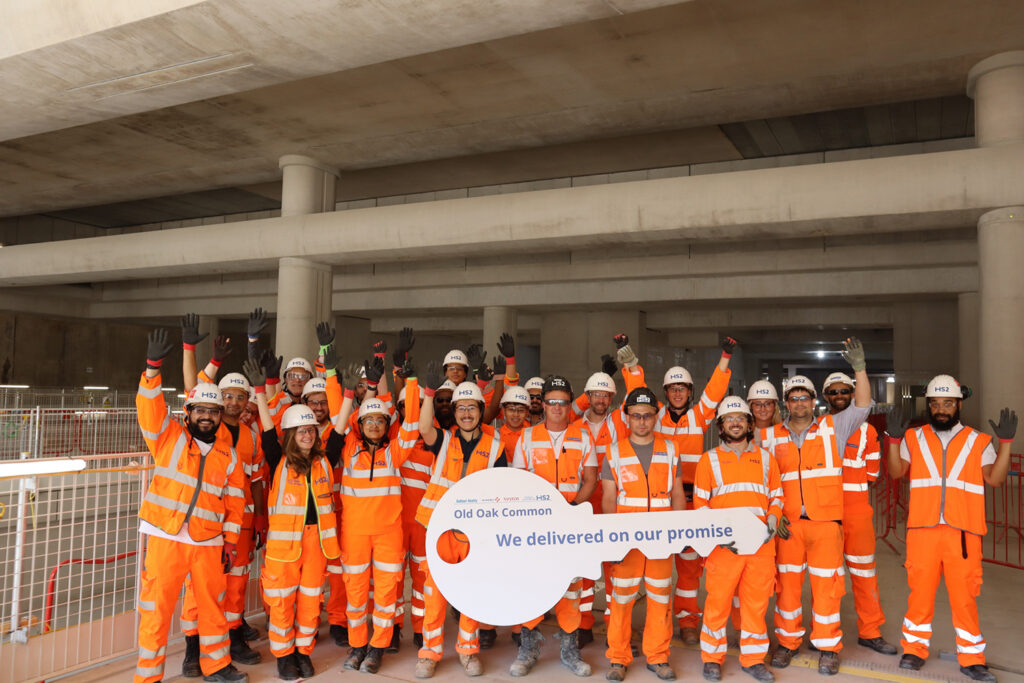
Kim Kapur, HS2’s Old Oak Common Area Director, said: “Going into the underground box at Old Oak Common, you can immediately visualise how it will look as an operational station, including where passengers will board or alight HS2’s brand new trains. The scale of the work – and the station now taking shape – is remarkable.
“However, there is much more to do. This includes construction of the conventional, surface level platforms, completion of tunnels either side of the underground box and installation of the impressive station roof, which will begin next year.
“Old Oak Common will be transformative for the local area, providing a new transport hub, with a new vibrant neighbourhood developing around it.”
Steve O’Sullivan, Project Director, Balfour Beatty VINCI SYSTRA joint venture, said: “This achievement reflects the expertise of our multidisciplinary teams who have worked collaboratively to deliver one of the most technically challenging stations currently being built in the UK, drawing on world-class engineering, specialist knowledge and a shared commitment to excellence.
“As the full scale, form and function of the station is starting to come into view there is a tremendous sense of pride in what has been accomplished so far to transform an ambitious design into a functioning transport hub, with our focus now on progressing works into the next phase.”
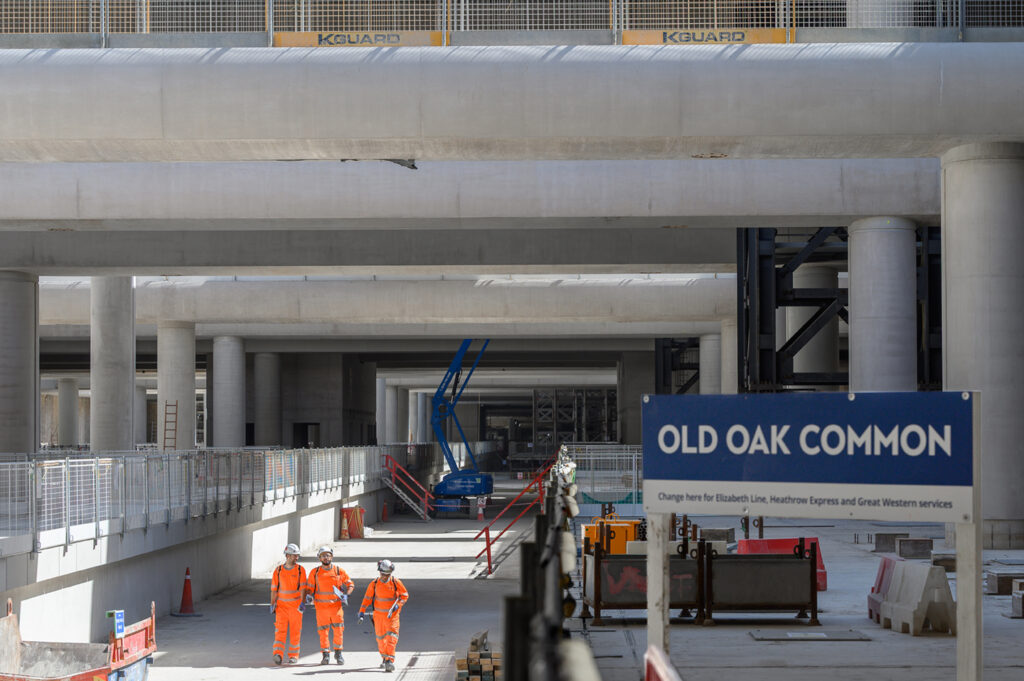
HS2’s CEO Mark Wild is continuing to lead a fundamental reset of the project, and a new detailed programme of work is being developed and agreed. At Old Oak Common, construction momentum continues to build, with HS2’s London tunnels contractor, Skanska Costain STRABAG, due to break through via the west wall of the underground box soon. This will connect the station to the Northolt Tunnel and open it up to wider HS2 route further north.
At the same time, work continues on the Euston Tunnel being built to the east of the station, which will eventually connect Old Oak Common with HS2’s central London terminus. Two tunnel boring machines were launched from the station box at the start of this year and are expected to complete their journey to Euston in 2027.
The connectivity at Old Oak Common will come from the multiple existing lines that are served such as the Great Western and Elizabeth Line. Work to build the overground platforms is ongoing, with the first platforms slabs due to be installed later this year. The team is also now looking forward to the station coming further out of the ground, with the first part of the stations vast roof going in early next year.
In addition to the additional capacity that HS2 will create on the southern section of the West Coast Main Line, creating more train paths for more frequent and reliable local and regional services, HS2 is spearheading local economic growth around its stations.
Economic research, published by HS2 last year, shows a £10bn boost in the areas surrounding its new station site in west London. Within 1.5 miles of Old Oak Common Station, HS2 will be responsible for generating over 22,000 homes, 693,000 square metres of commercial floorspace, and 18,782 jobs, the research, conducted by Arcadis, found.
Read more about high speed rail solutions at SYSTRA
View more about our projects on HS2
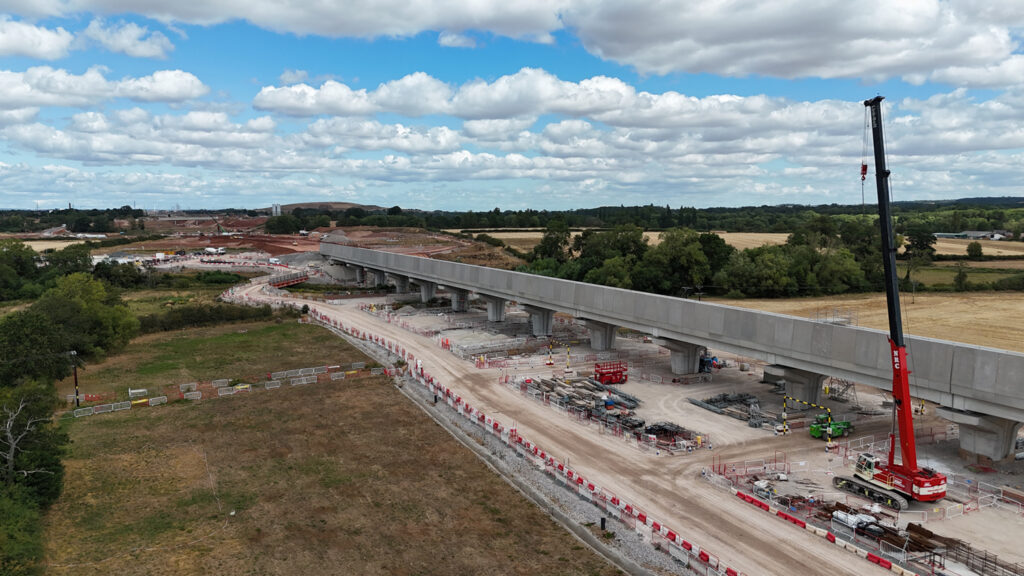
Trio of Viaducts Complete on HS2The trio of viaducts – Balsall Common, Marsh Farm and River Blythe – are all within the Solihull metropolitan borough, on the southern approach to Interchange station.
Next, engineers working for HS2’s construction partner, Balfour Beatty VINCI, will install the final parapets on the River Blythe Viaduct – the largest of the three bridges that carry the high-speed railway through Solihull, and the closest to Interchange Station – approximately 1.5 miles away.
Marsh Farm Viaduct was the first of these neighbouring structures to reach completion in summer 2025. The main structure of Balsall Common Viaduct was finished earlier this year, and all 304 parapets will be installed by spring 2027.

“The structural completion of these three viaducts is a significant milestone for the project and an important moment for SYSTRA, working alongside Mott MacDonald in the Design Joint Venture.
It’s a real reflection of the technical expertise, innovation and collaboration behind this sublot, and of the global effort across our business to turn that design work into built infrastructure on site. I’m immensely proud of how our teams have come together to solve complex engineering and environmental challenges and help bring the project to this point.”
Tim Noble, Sublot Manager, SYSTRA Ltd
Doug Barnett, HS2 Ltd’s senior project manager said: “Our engineering teams are making fantastic progress on the Interchange Station approach, and it’s a significant achievement that all three viaducts in the Solihull borough are now structurally complete.
“The design and landscaping solutions were of upmost importance to local residents, and we worked extremely hard to get that right.”
River Blythe Viaduct
Both the River Blythe Viaduct and Balsall Common Viaduct are ‘Key Design Elements’ (KDEs), which means their size, proximity to communities, or location within sensitive areas, marked them out as significant. Local communities therefore helped to influence their design.
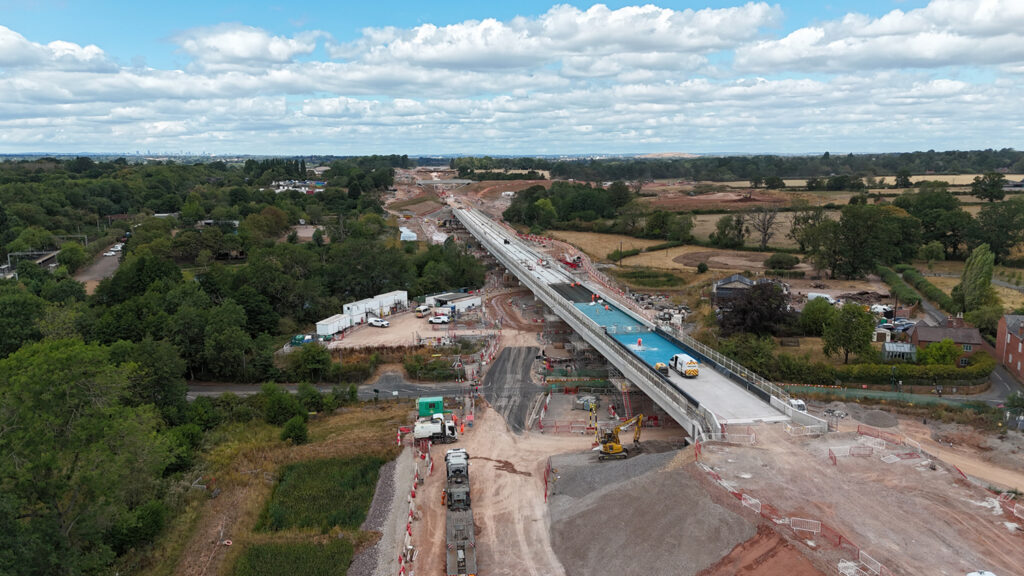
As the River Blythe is designated as a Site of Special Scientific Interest (SSSI), the 495-metre-long viaduct was built with this in mind. The low-lying 12-metre-high structure skims the landscape as it crosses the river, the floodplain and Meriden Road near Hampton in Arden.
The deck is supported by two abutments and 19 concrete piers with Y-shaped splits to reduce the volume of concrete and enhance the aesthetic appeal. Local communities opted for larger-sized polished parapets to one side of the structure and were consulted on the tree planting that will help to blend the viaduct into the landscape.
The space under the viaduct will allow safe passage for a range of species, including dispersal routes for badgers, bats, birds, fish, great crested newts, otters and water voles. The design will also allow views through and around the viaduct, and the polished concrete acoustic parapets will visually reduce the mass of the structure, as well as minimising noise for local residents.
Now structurally complete, engineers will carry out the finishing touches, adding acoustic barriers and conducting final water proofing works.
Marsh Farm Viaduct
Two and a half miles south is the smallest of the three structures – Marsh Farm Viaduct, which carries the HS2 main line over Bayleys Brook and surrounding marshland.
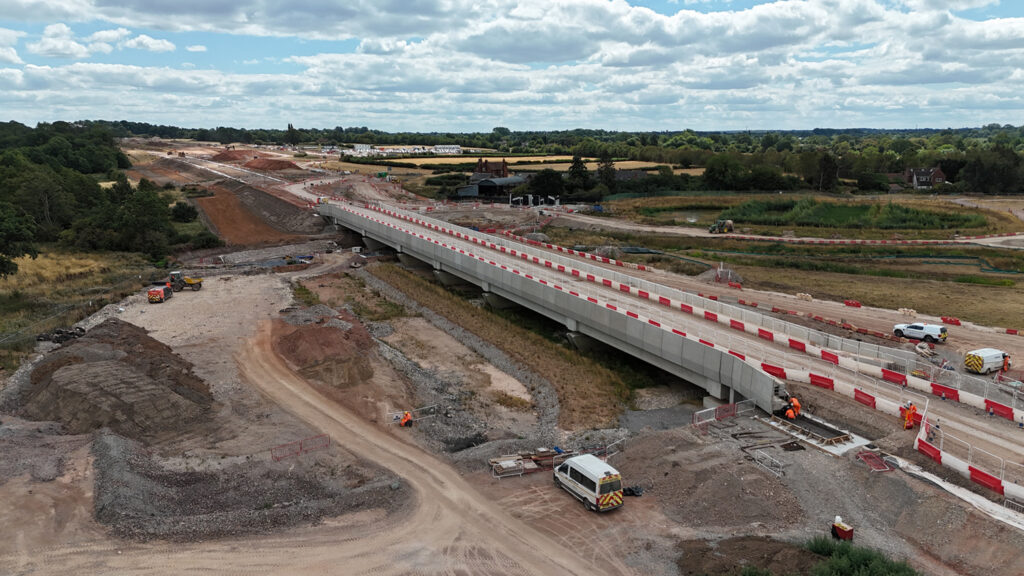
Standing just five-metres above ground, the 145-metre-long viaduct is currently being used as a haul road to support construction of the adjacent embankments and cuttings, while reducing the number of lorries on local roads.
Balsall Common Viaduct
Just outside of the residential area of Balsall Common village stands the 430-metre-long Balsall Common Viaduct. Constructed to north-east of the existing Network Rail line, the eight-metre-high viaduct crosses Station Road, Truggist Lane, Bayleys Brook, Heart of England Way walk and the associated floodplain.
Now complete, engineers will begin installing the parapets, which were chosen by the local community. A public vote determined that the parapets would be designed with a polished finish to reflect the sky and surrounding vegetation, and that the viaduct would feature a unique weave motif in a nod to the area’s history of textile production.
Matthew Parkes, Construction Manager at Balfour Beatty VINCI said: “The structural completion of these viaducts is a huge another achievement for Balfour Beatty VINCI and its supply chain partners. All three viaducts span a range of diverse landscapes and environments, including wetlands, floodplains, SSSIs and water courses – making this achievement even more remarkable.
“Every effort has been made to protect these precious spaces and habitats. The realignment of Bayleys Brook is just one example of how the team has delivered on this commitment, where engineers carefully diverted a 150-metre section of the brook to allow Balsall Common Viaduct to pass over the top.”
The HS2 route has more than 500 bridging structures – including over 50 major viaducts which will stretch for a combined total of 15 kilometres (9 miles) across valleys, rivers, roads and flood plains.
When complete, Britain’s new high-speed railway will create quicker and more reliable journeys, driving economic growth while crucially freeing up space for more local trains on the most congested part of the West Coast Main Line.
From Interchange station, passengers will be able to travel to London Euston and HS2’s new superhub station Old Oak Common, which will be directly linked to over 100 locations in the UK.
Read more about high speed rail solutions at SYSTRA
View more about our projects on HS2
FUSION: How SYSTRA’s groundbreaking study will transform the future of travel data in the UKThe Department for Transport’s (DfT) FUSION project, led by SYSTRA with research partners TravelAi and Yonder Data Solutions (YDS), set out to tackle one of the biggest challenges in UK transport planning: the lack of accurate, high-resolution, longitudinal data on how different people actually travel.
In an era shaped by the rise of micromobility, fragmented multimodal travel and hybrid working patterns, the limitations of traditional data collection methods have become increasingly apparent and are now starting to show their age. More may be possible using new data sources, such as from mobile phones, and tools, such as AI.
FUSION set out to understand whether a new, scalable method can be developed to integrate high-volume smartphone-sensor derived ‘big data’ collected through the MyWays app with traditional contextual survey ‘deep data’ such as socio-demographic information and qualitative insights. Together these data sources will provide a much richer picture of travel behaviour, fusing the where, when and how with the why. This then provides demographic information which allows specific policy and evaluation needs to be targeted. Using privacy-preserving methods and advanced analytics, the project demonstrated how these emerging datasets can enhance, validate, and modernise the evidence base used in UK transport planning.
The FUSION project demonstrates how the UK can evolve from the occasional, survey-dependent insights into capturing timely, dynamic real-world travel behaviour insights that are capable of supplying policymakers with an ongoing, reliable evidence base. It offers a blueprint for a new era of data-driven transport policy, one where real-world movement patterns can be monitored continuously, analysed responsibly, and used to build a more efficient, safer, more inclusive transport system for the UK and perhaps beyond.
Contact our team here to find out more about the FUSION project and the services our specialists can provide.
To download the full report, click here.
SYSTRA works with social mobility charity for a second yearThe Social Mobility Commission states that only 16% of young people who are eligible for free school meals attain at least two A-Levels by the age of 19. The Career Ready programme is structured to enable young people to who potentially face barriers in educations and employment to develop skills and confidence and to give them experience of the workplace. 98% of their 2024 alumni went on to higher education, work or apprenticeships.
SYSTRA is once again proud to be partnering with Career Ready to provide paid internships for those on the programme, and champion equality, diversity and inclusion (ED&I) in the engineering and transport sectors. The partnership reflects SYSTRA’s commitment to enhancing the company’s capabilities and capacity for innovation through the prioritisation of ED&I.
Offering opportunities for young people to embark on STEM careers is fundamental to SYSTRA’s success as well as the company’s wider mission to provide safe and resilient transport and infrastructure solutions, now and in the future.
Career Ready has worked with a broad range of employers throughout the UK for more than 20 years. The charity’s structured programme of mentoring, paid internships, masterclasses and workplace visits, aims to empower young people from under-represented backgrounds. Experts work to connect 15-18-year-olds directly with the workforce, providing experiences, insights and a support network.

The charity collaboration also adds real business value, enabling SYSTRA’s network of skilled colleagues to engage and upskill, supporting all early careers professionals, including interns, through training and mentorship.

At Career Ready, we’re delighted to work with partners like SYSTRA to provide young people with paid internships and mentors. Together, we help young people develop the skills, experience, and confidence to kickstart their futures and achieve their potential in life.
Caroline Emery, Regional Manager for Birmingham, Career Ready
Ahnaff Abedin, who has just completed his internship with SYSTRA through Career Ready, said “SYSTRA has provided me with such a fresh perspective of the world of work with its wide range of job roles and inclusive community. “
“During my time at SYSTRA, I have developed numerous, transferrable skills whilst also experiencing hands on work.
“Everyone at SYSTRA has been very supportive and welcoming, as well as giving me valuable advice and insights into my future career.”

SYSTRA has provided me with such a fresh perspective of the world of work with its wide range of job roles and inclusive community
Ahnaff Abedin, Intern, SYSTRA Ltd. through Career Ready
SYSTRA Associate and Mentor, Lauren Richards, said: “As Ahnaff’s mentor since the start of the year through the Career Ready programme, I’ve really enjoyed seeing him grow and develop a wide range of skills during his internship. It’s been rewarding to watch the positive impact SYSTRA has had on his development, and I’m excited to see where his journey takes him next.”
Find out more about our early careers opportunities.
SYSTRA supports road safety charity BrakeAlongside a one-off donation on behalf of the company, colleagues will be taking part in fundraising and road safety awareness campaigns over the coming year.
Established in 1995, Brake has a vision of a world where no one is killed or hurt on a road. Five people die on the UK’s roads every day, and more than 15 times as many people are seriously injured.

Brake’s work includes:
- Campaigning to stop crashes on our roads and reduce harm where crashes happen.
- Helping people affected by road death and injury get the support they need, for as long as they need it.
- Delivering education programmes to improve knowledge, develop skills, and shift attitudes.
Nick Salt, CEO at SYSTRA, said: “I’m proud that SYSTRA can support this fantastic charity in their vital work to help make our roads safer.
“Our specialists in areas such as collision analysis, transport planning, and highways design are helping to make our roads safer through the work we deliver for clients, so our partnership with Brake is an excellent fit.
“Throughout the year we will be getting involved in the charity’s campaigns and holding fundraising activities to help raise additional awareness and donations.”
Ross Moorlock, CEO at Brake, said: “We are delighted that SYSTRA has chosen Brake as its charity partner. In 2025 alone, an estimated 1,556 people were killed and more than 28,000 sustained serious injuries on Britain’s roads.
“Brake’s National Road Victim Service supports more than 2,000 people a year in their darkest times, helping them to navigate the trauma that follows a crash and tackle some of the practical challenges they face.
“This partnership will help to make sure bereaved and seriously injured road victims are not left to cope alone.
“Thanks to SYSTRA’s generous donation, we are also better placed to continue our education and campaigns work, raising awareness of the devastating impact of road crashes on everyone involved, and striving to achieve our vision of a world where no one is killed or injured on a road. Thank you to everyone at SYSTRA.”
Find out more about Brake on their website: https://www.brake.org.uk/ and support their work via SYSTRA’s JustGiving page: https://www.justgiving.com/page/systra-brake
Making transport safer is at the heart of SYSTRA’s work, from transport planning and pedestrian modelling, to highways design and stakeholder engagement. Find out more.
SYSTRA and Civic partner to support local authorities through Scotland Excel’s frameworkThe two companies, which both have offices in Glasgow and Edinburgh, have been appointed to seven lots on the framework which provides all Scottish local authorities and eligible public sector bodies access to engineering and technical consultancy support.
The partnership will offer them direct access through the framework to a broad range of SYSTRA and Civic’s specialist expertise across masterplanning, transport, infrastructure, structures, environment, geoconsultancy, drainage and flooding, and project management and delivery.
Malcolm Neil, Business Director at SYSTRA, said: “Our work alongside Civic reinforces our commitment to helping councils respond to local priorities with solutions that are practical, sustainable and shaped around the needs of communities.
“Through this framework, SYSTRA and Civic are well placed to help local authorities and public sector bodies plan, design and deliver projects that meet immediate service needs while also supporting longer-term place and infrastructure strategies.”
Combined, SYSTRA and Civic’s partnership brings together their teams’ expertise in transport and infrastructure, built environment engineering, environment and sustainability and place-led delivery.
Isla Jackson, director and head of Civic’s Scotland studio, said: “We know that councils are balancing a wide range of pressures and ambitions, from improving connectivity, biodiversity and resilience, to supporting regeneration, decarbonisation, accessibility and inclusive economic growth.
“This partnership creates a strong offer for councils looking for trusted partners who can provide both strategic advice and practical delivery support, while creating positive impact for people, place and the planet.”
Civic, the team of system thinkers in the built environment, is involved in major schemes across Scotland that champion sustainable, inclusive design, including: Glasgow Avenues; Mantle Yard in Leith; Custom House Quay and Edinburgh Innovation Hub.
Contact Malcolm Neil to find out more about our services.

SYSTRA joins partners to celebrate landmark graduation of PlanBEE Rail apprentices
The event marked a milestone moment for the scheme and celebrated the achievements of its inaugural cohort.
Through the Transpennine Route Upgrade (TRU) East Alliance, SYSTRA in the UK & Ireland is a proud founding member of the PlanBEE Rail scheme, which is designed to recruit and nurture the next generation of multi-disciplinary project managers.
The two-year programme supports the apprentices as they rotate around four different employers, gaining experience across different environments.
The event brought together apprentices, their friends and family, and representatives from sponsor organisations for a celebratory evening, including certificate presentations, alongside a poster showcase.

It has been a real honour for SYSTRA to be part of the PlanBEE Rail apprenticeship scheme and to support the development of such a talented first cohort.
Annabel Snowden, Senior Early Careers Talent Advisor
Annabel Snowden, Senior Early Careers Talent Advisor at SYSTRA, said: “It has been a real honour for SYSTRA to be part of the PlanBEE Rail apprenticeship scheme and to support the development of such a talented first cohort.
“The programme is a great example of what can be achieved when organisations across the rail industry work together to nurture future talent – offering broad experience and a strong foundation for long term careers.
“We are proud to have played a role in this important initiative and to celebrate the achievements of the apprentices.”
The graduation serves as a proud demonstration of our collaborative commitment to developing the next generation of rail professionals across the industry.
SYSTRA welcomed apprentices Joe Thompson, Rachael Ngoka, Amelia Edwards and Elliot Morrison during the programme. On the back of the placements, we’re delighted to say Elliot has been offered a permanent job with us as project coordinator.
Visit our early career pages to learn more about the opportunities on offer at SYSTRA.